
Salher advances new wastewater treatment solutions using SBR technology
Salher has supplied a wastewater treatment plant using SBR (Sequencing Batch Reactor) technology for a hospital in the Dominican Republic, with a treatment capacity of 400 m³/day. This solution offers flexibility in the biological treatment process and a high degree of adaptability to variations in flow rate and pollutant load.
This project for the Dominican hospital sector builds on Salher’s experience in sequencing batch reactors. Drawing on this expertise, the company is advancing the development of new biological treatment solutions that can be implemented in modular panel tanks or concrete structures. These solutions are particularly suitable for industries with intermittent discharges or variable wastewater composition, as well as facilities with specific treatment requirements.
What is SBR technology and how does it work?
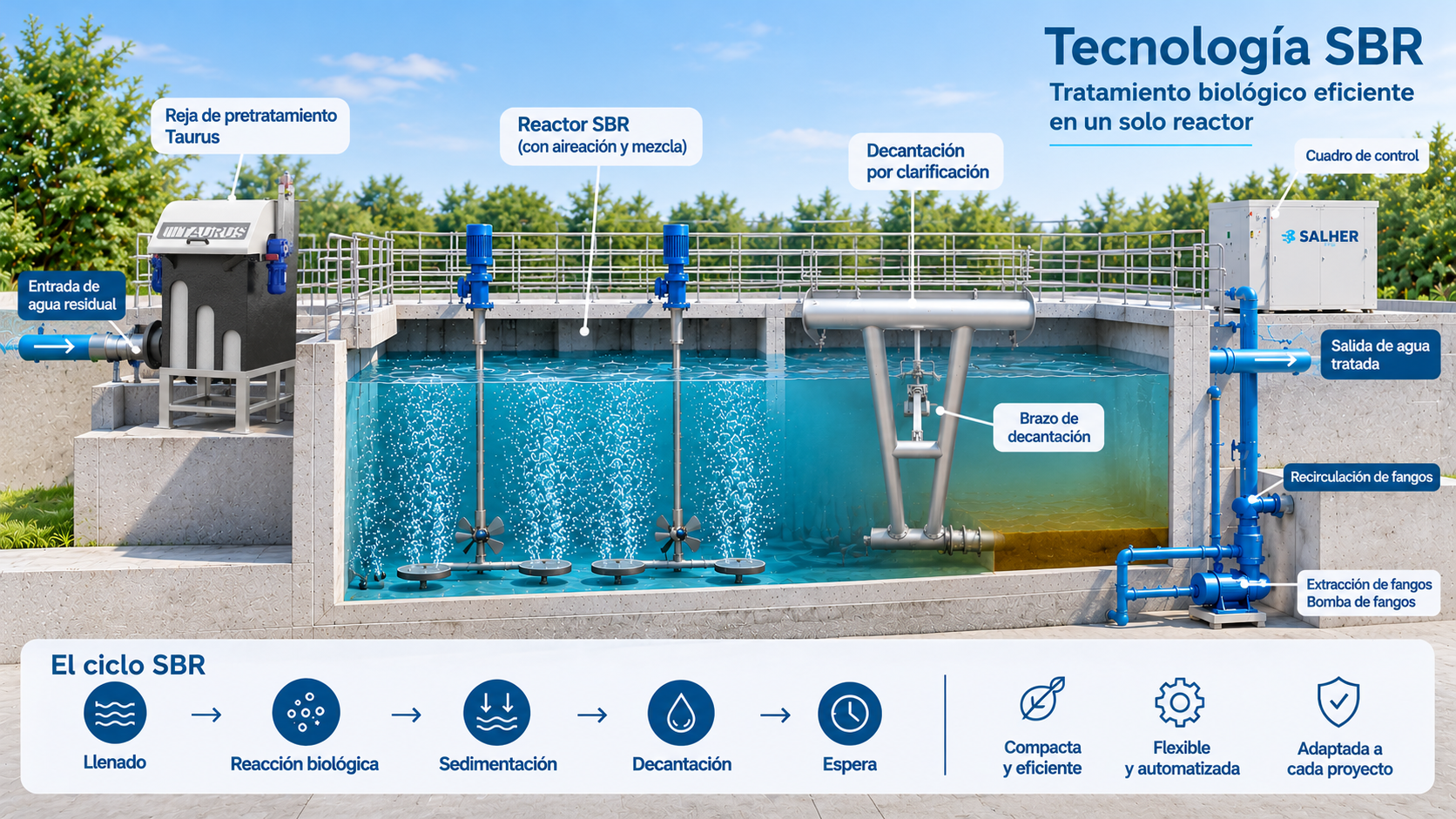
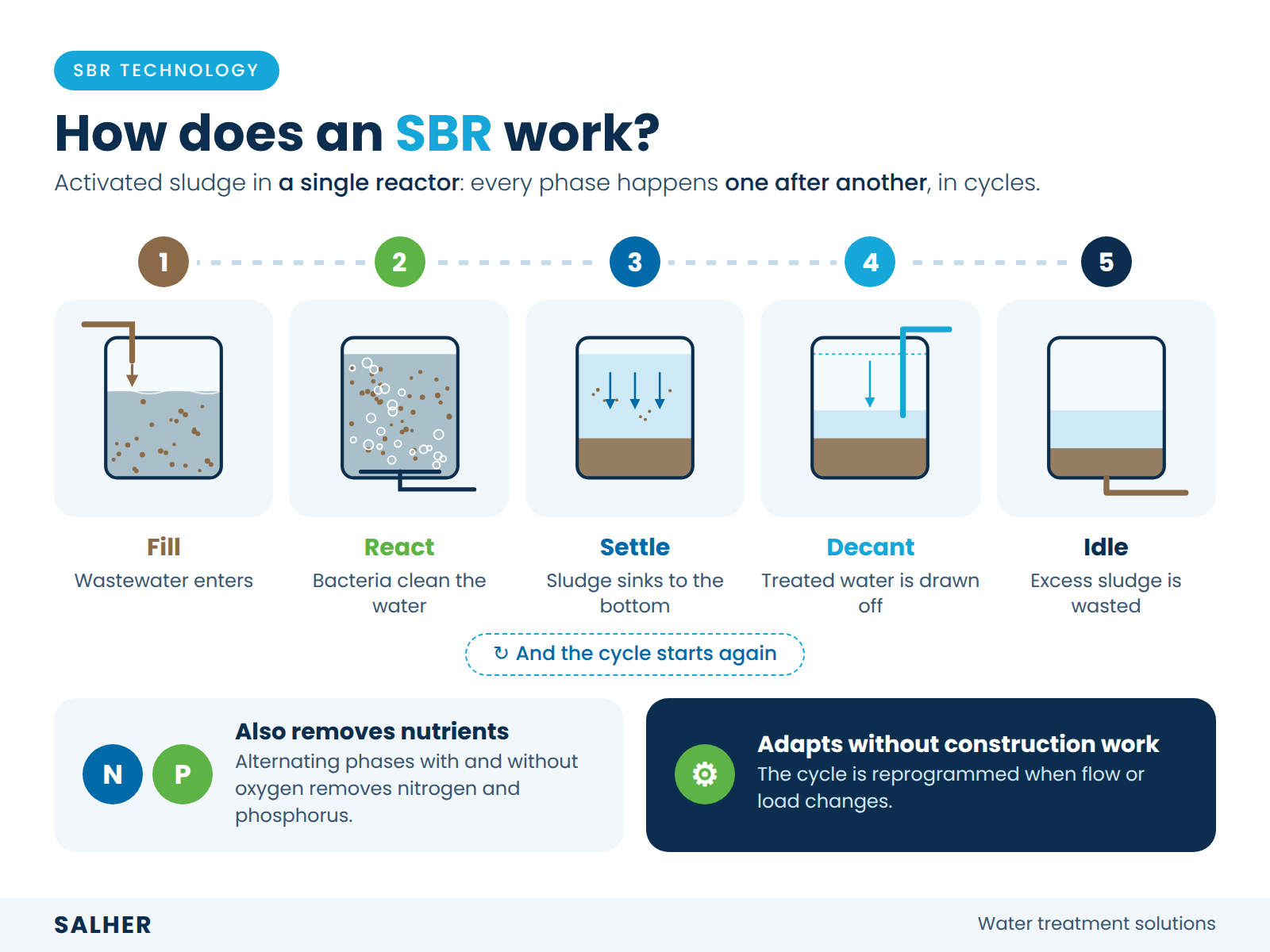
SBR systems are a type of activated sludge process that allows treatment to operate in batches over time rather than continuously through space, while maintaining the same biological principle and biomass. Unlike conventional continuous-flow systems, the different treatment stages take place sequentially within a single reactor.
The process is organised into cycles comprising reactor filling, biological reaction, solids settling, treated water decanting and, when required by the system design, a resting period before the next cycle begins. The duration and operating conditions of each stage are adjusted to the characteristics of the wastewater and the treatment objectives.
Depending on the system configuration and operating conditions, SBR technology can also promote the removal of nutrients such as nitrogen and phosphorus. Settling then allows the sludge to be separated from the treated water before the latter is discharged.
Each operating cycle consists of several consecutive phases. During filling, wastewater enters the reactor. During the reaction phase, the biomass breaks down organic matter under aerobic conditions, or through alternating aerobic and anoxic periods. During settling, with aeration and mixing switched off, the sludge separates by gravity under virtually static conditions. During clarification, the clarified supernatant is withdrawn. Finally, when required by the system design, a resting phase takes place before the next cycle begins. This phase can be used to remove excess sludge.
The duration and operating conditions of each phase are programmed according to the characteristics of the incoming wastewater and the required effluent quality. This makes it possible to readjust the treatment process throughout the installation’s service life in response to changes in flow rate or pollutant load, without requiring structural modifications.
By appropriately sequencing aerobic, anoxic and anaerobic conditions within a single cycle, the system can promote biological nutrient removal. Nitrogen is removed through nitrification and denitrification, while phosphorus can be removed through its accumulation in the biomass and subsequent removal through excess sludge wasting. The achievable performance depends on the system configuration and operating conditions.
Salher develops SBR solutions for a range of sectors, from industrial and hospital facilities to larger-capacity projects, including certain municipal applications. To meet these needs, the company designs solutions using both modular panel tanks and concrete structures, adapting them to the flow rates, wastewater characteristics and requirements of each facility.
Where discharge limits or intended water reuse applications require it, the biological treatment process can be complemented by tertiary treatment stages to achieve higher effluent quality.
With this approach, Salher continues to explore new solutions to address the challenges of wastewater treatment across industrial, hospital and municipal applications.
Latest news
Salher proposes compact solutions to increase WWTP capacity without expanding the existing facility
Increasing flow rates and more stringent discharge requirements are leading many wastewater treatment plants to seek new ways to increase their treatment capacity without undertaking major...
New urban wastewater directive: how to adapt WWTPs to quaternary treatment and micropollutants ?
The new Directive (EU) 2024/3019 tightens wastewater treatment requirements and places a stronger focus on micropollutant removal, water reuse, energy efficiency and circularity. Salher is preparing...
How to eliminate the chlorine smell in swimming pools? Salher introduces new ozone water treatment solutions
The characteristic chlorine smell in swimming pools, irritated eyes and dry skin are no longer unavoidable. Ozonation is rapidly becoming the preferred water treatment technology for facilities...
Salher Products
Designed and developed to meet all the requirements in water treatments.

Services

Project and Design
Engineering development and projects management.

Manufacturing
Production of GFRP, polypropylene and steel equipment.
Assembly of modular equipment and integration in civil works.

Supply
Selection of equipment and instrumentation to provide an integral water treatment solution.

Commissioning
Technical assistance in the electromechanical and electrical assembly of every water treatment plant.

Maintenance
Post-installation control service by a qualified technical staff.

Courses & documentary support
Practical training and delivery of manuals of operation, commissioning and maintenance.

salher@salher.com
Carrera Toledana, 33. Arganda del Rey. Madrid 28500. Spain.
+34 91 870 00 15
Spain / +34 91 870 00 15
Poland / +48 22 737 24 95
Portugal / +351 234 795 821
Engineering – Wastewater treatment – Purification – Liquid/solids separation equipment for industrial and municipal process applications – Surface water – Groundwater – Water Reuse – Drinking Water – Hydrocarbon and Oil Water Separation