

Reuse water, a sustainable future investment
Circular economy, climate emergency, sustainability. Over the last few months, these concepts fill the pages of the mainstream media and are studied in universities around the world. In an increasingly globalized environment, the scarcity of resources is a reality and, although from Europe the need to reuse water seems unthinkable, according to UNICEF data, 2,100 million people in the world do not have access to drinking water.
The United Nations Sustainable Development Goals estimate that by 2050 at least 25% of the world’s population will live in a country affected by a shortage of fresh water. Given this scenario, it is essential to work on water reuse projects, for which Salher has several solutions.
What is water reuse?
The process of reusing water consists in giving a new useful life to water that previously had a domestic or industrial use. To this end, these waters must firstly be treated and, secondly, a tertiary treatment such as those proposed by Salher is required to obtain regenerated waters according to the required parameters.
Conventional wastewater treatments ensure a quality that allows to pour water without risk to the environment, but if we want to reuse it for agriculture, industry or other domestic uses, the water quality must be higher.
What is reuse, from a technical point of view?
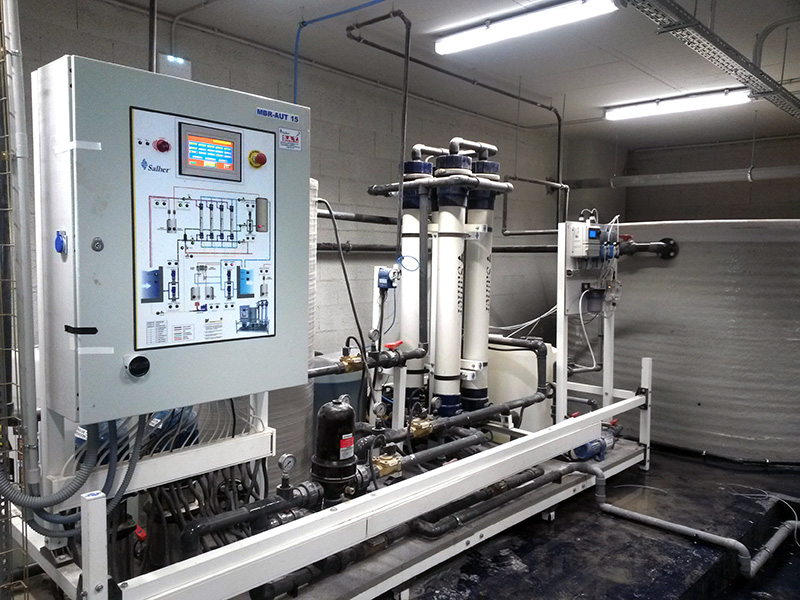
Salher’s compact reuse plants offer countless configurations to meet any required water quality or intended use. They are a set of refining elements for the treatment of grey water from showers, bathtubs and sinks and domestic and industrial wastewater previously treated.
In a first stage, this treatment includes a sand filter system or an ultrafiltration system. In the latter case, if the reuse of water were immediate, this first phase would be sufficient. However, most of the time this water is not reused immediately and is accumulated in a tank.
Therefore, a second stage is necessary for its subsequent reuse. This consists of a disinfection system, a maintenance chlorination, which can be by hypochlorite, ozone or ultraviolet radiation.
In those cases in which the water was not first subjected to a treatment process, there is the option of supplying a membrane bioreactor (MBR), which will combine both technologies: active sludge and ultrafiltration.
The waters regenerated by these processes can be used as refill of toilet tanks, irrigation (agricultural, green areas and golf courses), sewer cleaning, street washing, fire systems, industrial vehicle washing, industrial processes or aquifers recharging and regeneration of rivers and wetlands.
Reuse as a paradigm of the circular economy
The implementation of a water reuse system implies an important initial economic investment, which is amortized over the years in those facilities where high grey water consumption is generated. Thus, places where it would be interesting to install a reuse plant, since a large amount of water is consumed and easily reusable waters are generated, are hotels, gyms and car washes.
Beyond the ecological aspect and long-term money savings, another incentive that motivates many companies to install Salher water reuse systems is to obtain sustainable labels and certifications for their buildings. In Spain, there is the LEED certification, the BREEAM and the green label, which also allow the saving of taxes such as the IBI (LVT) in Spain.
Water reuse Salher plants examples:

Iberdrola Campus, San Agustín de Guadalix (Madrid)
Hydrocarbon separator for 150 l / s of rainwater and Compact plant for the reuse of gray water by ultrafiltration.
La Vela Building – BBVA headquarters in Madrid (Spain)
4 Greywater reuse systems to recharge fluxores and 2 rainwater reuse systems for garden irrigation.

Dairy industry in Belarus
Planta de reutilización de aguas depuradas y pluviales para 1,500 m³/día por ultrafiltración y desinfección final mediante UV.
Reuse of water in Europe
The water stress suffered by some countries in southern Europe, such as Cyprus, Spain, France, Greece, Italy or Portugal, leads them to establish their own legislation on reuse. For example, in Spain, the Royal Decree 1620/2007 was drafted to increase water resources. This regulates the permits for the reuse of treated water, which due to lack of investment amounts to only 10.4% in the country.
For its part, the European Commission is in the process of approving a community regulation focused on agricultural irrigation to encourage the use of reclaimed water safely for the environment. In the end, water reuse is an easier and more reliable practice than transfers or desalination.
The predictions say that, with a European regulation, the volume of reused water will increase to 6,600 million m³ per year in 2025, from the current 1,100 million.

Latest news
How to eliminate the chlorine smell in swimming pools? Salher introduces new ozone water treatment solutions
The characteristic chlorine smell in swimming pools, irritated eyes and dry skin are no longer unavoidable. Ozonation is rapidly becoming the preferred water treatment technology for facilities...
Why hydrocarbon separation remains a critical part of industry?
In many industrial processes, from oil extraction and fuel refining to fleet washing and manufacturing operations, water comes into contact with hydrocarbons. Salher® hydrocarbon separators are...

New Salher ozonation range: proprietary technology for water and air treatment
At Salher, we continue expanding our technological portfolio with a new range of ozonation systems designed to cover everything from small installations to large industrial processes: the new OZW...
Salher Products
Designed and developed to meet all the requirements in water treatments.

Services

Project and Design
Engineering development and projects management.

Manufacturing
Production of GFRP, polypropylene and steel equipment.
Assembly of modular equipment and integration in civil works.

Supply
Selection of equipment and instrumentation to provide an integral water treatment solution.

Commissioning
Technical assistance in the electromechanical and electrical assembly of every water treatment plant.

Maintenance
Post-installation control service by a qualified technical staff.

Courses & documentary support
Practical training and delivery of manuals of operation, commissioning and maintenance.

salher@salher.com
Carrera Toledana, 33. Arganda del Rey. Madrid 28500. Spain.
+34 91 870 00 15
Spain / +34 91 870 00 15
Poland / +48 22 737 24 95
Portugal / +351 234 795 821
Engineering – Wastewater treatment – Purification – Liquid/solids separation equipment for industrial and municipal process applications – Surface water – Groundwater – Water Reuse – Drinking Water – Hydrocarbon and Oil Water Separation