

Salher has commissioned its latest project to treat water generated by an agri-food industry in Guatemala
Salher’s most recent project in Guatemala consists of a treatment plant to reduce the generation of wastewater in the manufacturing process of an agri-food industry dedicated to the production of banana purée. For this purpose, this WWTPi includes a biological reactor and a reuse system through ultrafiltration.
On this occasion, Salher has developed all the phases of the project, from the engineering, the design of the water line and the manufacture and supply of the equipment that make it up, to its commissioning. The main conditioning factor prior to the design of this plant was that the client required the optimisation of an existing civil work at the facility, which meant a space limitation and, for this reason, MBBR technology was chosen for its biological reactors.
The most characteristic problem of wastewater generated by the agri-food industry is its high organic pollutant load. The design of this industrial wastewater treatment plant for 100 cubic metres per day had to take into account the variation in pollutant loads throughout the day and peak flows. Therefore, in order to laminate flows and to homogenise pollutant loads, Salher included a homogenisation tank that feeds a Vespa model DAF to reduce them before the biological phase.
Discover more features of our cylindrical dissolved air flotator in the following video:
Beyond water treatment, what can we do to reduce the volume of wastewater?
What in other areas involves individual responsibility and self-control, in the industrial sector is very difficult to control and most of the time the only option to reduce the consumption of fresh water and the generation of wastewater in factories is through reuse. Salher offers compact solutions to meet the needs of each factory.
For this banana industry, Salher has installed a compact water reuse plant using ultrafiltration technology that will allow the irrigation of the factory’s green areas. In addition, thanks to Salher’s sludge collection system, the company is going to reuse the sludge as fertiliser for these green areas.

Latest news
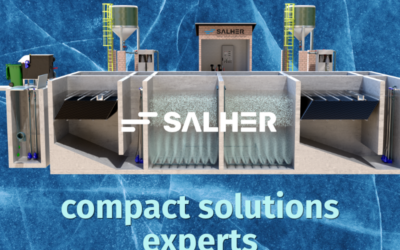
Salher proposes compact solutions to increase WWTP capacity without expanding the existing facility
Increasing flow rates and more stringent discharge requirements are leading many wastewater treatment plants to seek new ways to increase their treatment capacity without undertaking major...
New urban wastewater directive: how to adapt WWTPs to quaternary treatment and micropollutants ?
The new Directive (EU) 2024/3019 tightens wastewater treatment requirements and places a stronger focus on micropollutant removal, water reuse, energy efficiency and circularity. Salher is preparing...
How to eliminate the chlorine smell in swimming pools? Salher introduces new ozone water treatment solutions
The characteristic chlorine smell in swimming pools, irritated eyes and dry skin are no longer unavoidable. Ozonation is rapidly becoming the preferred water treatment technology for facilities...
Salher Products
Designed and developed to meet all the requirements in water treatments.

Services

Project and Design
Engineering development and projects management.

Manufacturing
Production of GFRP, polypropylene and steel equipment.
Assembly of modular equipment and integration in civil works.

Supply
Selection of equipment and instrumentation to provide an integral water treatment solution.

Commissioning
Technical assistance in the electromechanical and electrical assembly of every water treatment plant.

Maintenance
Post-installation control service by a qualified technical staff.

Courses & documentary support
Practical training and delivery of manuals of operation, commissioning and maintenance.

salher@salher.com
Carrera Toledana, 33. Arganda del Rey. Madrid 28500. Spain.
+34 91 870 00 15
Spain / +34 91 870 00 15
Poland / +48 22 737 24 95
Portugal / +351 234 795 821
Engineering – Wastewater treatment – Purification – Liquid/solids separation equipment for industrial and municipal process applications – Surface water – Groundwater – Water Reuse – Drinking Water – Hydrocarbon and Oil Water Separation