

Water technology serving industrial productivity: Salher process water treatment solutions
Every day, thousands of factories face the same question: what should they do with their process water? Should they discharge it while meeting regulations, treat it to stabilize production, or reuse it to reduce consumption and costs? At Salher, we turn that question into a plan. We analyze each case and design industrial water treatment solutions that transform water from a problem into a valuable resource.
What is process water?
Depending on its quality, water plays a key role in multiple stages of industrial production: cleaning, rinsing, CIP systems, cooling towers and boilers, raw material dissolution, product transport, or steam generation. All these flows are known as process waters.
Once used, their composition varies depending on the type of industry and process, but they typically contain residues of raw materials, oils, detergents, or dissolved salts. For this reason, they require appropriate treatment before discharge or reuse.

Process water in a paint factory in Malaysia

Multiquímica Centroamericana chemical factory, Guatemala

Pharmaceutical factory in Segovia, Spain
Process water is essential for production continuity, product quality, and industrial sustainability. Regulatory progress in Europe and the growing pressure to reduce consumption and discharges have accelerated the adoption of efficient technologies, internal reuse strategies, and circular economy models.
The EU Regulation 2020/741 on minimum requirements for water reuse strengthens the framework for producing safe, traceable reclaimed water, promoting quality standards and risk management plans.
To assess the suitability of these treatments, Salher considers:
- Specific water consumption of the facility
- Internal reuse rate and discharge reduction
- Energy consumption of the system compared to total factory use
- Carbon footprint
- Compliance with current environmental regulations
Salher designs tailor-made solutions for the treatment and production of process water, combining different purification technologies according to each project’s needs. From physico-chemical treatments to advanced biological systems, filtration, and disinfection, our plants are designed to ensure optimal, stable, and safe water quality.
In the initial phase, pretreatment systems like TAURUS homogenize flows and remove coarse contaminants. Then, coagulation-flocculation and dissolved air flotation (DAF) systems, such as Vespa or Xcorpio, remove suspended solids, oils, and turbidity.
After removing the most visible solids and oils, many industrial facilities incorporate biological processes to eliminate organic matter, nitrogen, or phosphorus. MBBR reactors (Moving Bed Biofilm Reactors) are particularly effective in handling variable loads.
When an exceptionally high effluent quality is required, MBR systems (Membrane Bioreactors) combine biological treatment with integrated membrane filtration. These biological technologies stabilize processes, reduce odors and emissions, and prepare water for reuse or polishing stages.
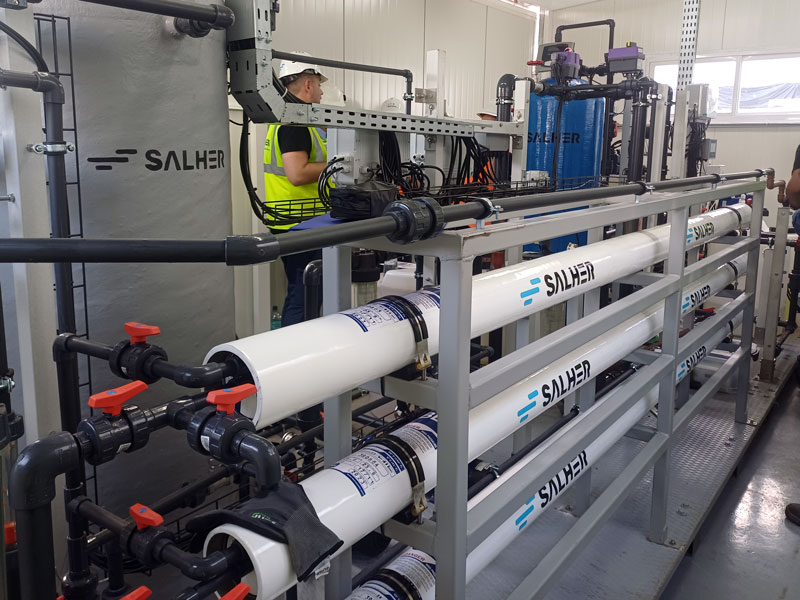
To achieve higher quality levels and promote circular economy principles, ultrafiltration membranes such as MAYA or nanofiltration systems are applied for fine clarification, color reduction, and dissolved organic matter removal.
For zero liquid discharge (ZLD) applications, reverse osmosis (RO) acts as a barrier against salts, inorganic matter, ions, and pathogens. Additionally, advanced oxidation processes (AOP), such as ozone and UV treatment, eliminate microcontaminants, odors, and persistent color.
On the other hand, digital transformation plays an increasingly important role in process water treatment. Salher’s R&D strategy focuses on integrating remote monitoring technologies into modular, client-adapted solutions.
Which industries benefit from process water treatment?
A wide range of sectors benefit from Salher’s industrial water treatment systems: food and beverage industries (e.g., dairy, canning, soft drinks), chemical and pharmaceutical plants, textile industries, metallurgical and energy generation industries. Each sector presents specific process water challenges. Salher’s tailored approach ensures maximum operational efficiency and regulatory compliance.
One recent success story involves a food processing factory in northern Greece, where Salher implemented an intensive filtration system to produce high-quality process water for a pickling plant — with outstanding results.
Installing an in-house process water treatment plant reduces dependence on external supplies and enhances the facility’s autonomy and sustainability. Once treated, process water can be reused in several ways:
- cooling systems,
- factory cleaning,
- irrigation of green areas,
- partial recirculation to reduce freshwater demand.
This allows companies not only to meet strict discharge limits but also to save on water consumption, management costs, and energy use, moving toward a more sustainable and competitive production model. Ultimately, Salher process water treatment solutions transform waste into an opportunity for efficiency and profitability.

We can help you
Contact us to evaluate the best solution for your process water treatment or reuse
Latest news

Europe tightens PFAS limits in drinking water, requiring the adoption of advanced treatment technologies
The entry into force of new mandatory limits for PFAS in drinking water across Europe since January 2026 is marking a turning point in the water treatment sector. To ensure their removal from water,...

What is water bankruptcy? Definition, causes and engineering solutions
Water bankruptcy refers to a situation in which more water is consumed than can be naturally replenished, treated, or sustainably managed, putting future availability, water quality, and economic...

Wastewater in the HORECA sector: a critical challenge for sustainability
Hospitality, restaurants and catering (HORECA) share a structural challenge that directly affects their operational, regulatory and environmental viability: wastewater management. Salher’s approach...
Salher Products
Designed and developed to meet all the requirements in water treatments.

Services

Project and Design
Engineering development and projects management.

Manufacturing
Production of GFRP, polypropylene and steel equipment.
Assembly of modular equipment and integration in civil works.

Supply
Selection of equipment and instrumentation to provide an integral water treatment solution.

Commissioning
Technical assistance in the electromechanical and electrical assembly of every water treatment plant.

Maintenance
Post-installation control service by a qualified technical staff.

Courses & documentary support
Practical training and delivery of manuals of operation, commissioning and maintenance.

salher@salher.com
Carrera Toledana, 33. Arganda del Rey. Madrid 28500. Spain.
+34 91 870 00 15
Spain / +34 91 870 00 15
Poland / +48 22 737 24 95
Portugal / +351 234 795 821
Engineering – Wastewater treatment – Purification – Liquid/solids separation equipment for industrial and municipal process applications – Surface water – Groundwater – Water Reuse – Drinking Water – Hydrocarbon and Oil Water Separation